
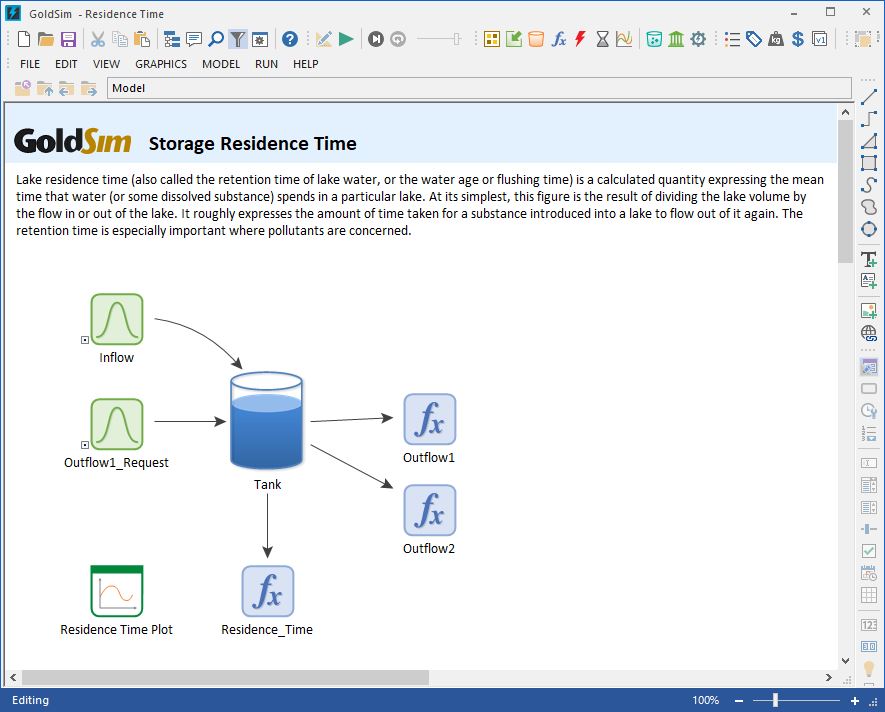
Lake residence time (also called the retention time of lake water, or the water age or flushing time) is a calculated quantity expressing the mean time that water (or some dissolved substance) spends in a particular lake. At its simplest, this figure is the result of dividing the lake volume by the flow in or out of the lake. It roughly expresses the amount of time taken for a substance introduced into a lake to flow out of it again. The retention time is especially important where pollutants are concerned.
Articles in this section
- Solute Mixing and Geochemical Equilibrium Example Models
- A Demonstration Model for Safety Assessment of Near-Surface Disposal of Low-Level Radioactive Wastes
- A Generic Performance Assessment Model for a Radioactive Waste Disposal Site
- Aquifer Example: Advection, Dispersion and Retardation in an Aquifer
- Calculating Saturation Indices in GoldSim
- Cell Example 5: Precipitate Removal Mass Flux Links
- Cell Example 6: Treatment Mass Flux Links
- Cell Pathway Example 1: Equilibrium Partitioning and Decay
- Cell Pathway Example 1: Equilibrium Partitioning, Decay, and Ingrowth
- Cell Pathway Example 2: Advection and Equilibrium Partitioning
Comments
0 comments
Please sign in to leave a comment.